
When Your Mind Tells You Something’s Wrong: Understanding Panic Attacks and Negative Thoughts
If you’ve ever found yourself mid panic attack, heart racing, chest tight, convinced that something is seriously wrong with you, I want you to know something important: you’re not alone, you’re not broken, and what you’re experiencing makes complete sense.
I hear it all the time in my counselling room. That phrase that comes up again and again: “I don’t know what’s wrong with me, but…” And then comes the rest. The worry that you’re losing control. The fear that you’re going crazy. The exhausting cycle of negative thoughts that seem to appear from nowhere and take over everything.
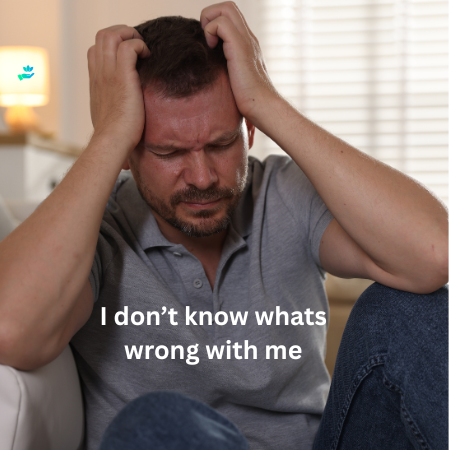
Here’s what I want you to understand: there’s actually nothing wrong with you. Your body and mind are doing exactly what they’re designed to do. They’re just doing it at the wrong time, for the wrong reasons. And once you understand why, everything starts to make more sense.
What Actually Happens During a Panic Attack
Let’s start with the basics, because understanding what’s happening in your body can take away some of the fear.
A panic attack is your body’s alarm system going off when there’s no actual fire. It’s your ancient survival mechanism, the one that kept our ancestors alive when they encountered dangerous predators, activating in response to something that isn’t actually life threatening.
When your body perceives a threat, real or imagined, it floods your system with adrenaline and other stress hormones. This is the famous “fight or flight” response. Your heart rate increases to pump blood to your muscles. Your breathing speeds up to get more oxygen. Your pupils dilate so you can see better. Blood rushes away from your digestive system and towards your limbs. You might feel dizzy, nauseous, shaky, or like you can’t catch your breath.
All of these sensations are deeply uncomfortable, but they’re not dangerous. In fact, they’re your body trying to protect you. The problem is that it’s protecting you from a threat that doesn’t exist, or from a threat that doesn’t require a physical response.
The physical symptoms of a panic attack typically include a racing heart, shortness of breath, chest tightness or pain, trembling or shaking, sweating, feeling dizzy or lightheaded, nausea or stomach upset, tingling sensations, feeling detached from reality, and an overwhelming sense of dread or fear. You might experience all of these or just a few. Some people describe it as feeling like they’re having a heart attack. Others say it feels like they’re going to pass out, lose control, or die.
And here’s the crucial bit: these symptoms, as awful as they feel, typically peak within about ten minutes and then gradually subside. Your body literally cannot maintain that level of intensity indefinitely. It’s physiologically impossible. The panic attack will end, even though in the moment it feels like it might last forever.
The Thought Panic Connection
Now, let’s talk about what’s really driving all of this: your thoughts.
Most people think panic attacks come out of nowhere. One moment you’re fine, the next you’re in the grip of terror. But when we look closer, there’s usually a thought pattern happening, often so quickly and automatically that you don’t even notice it.

This is where negative thoughts come in, and they’re far more powerful than most people realise.
Your brain is constantly scanning for danger. It’s doing this in the background, all the time, without you being consciously aware of it. When it detects something that might be a threat, it sends out an alert. Sometimes that alert is obvious. But often, it’s subtle. A fleeting thought. A worry that passes through your mind so quickly you barely register it.
Let me give you an example. You’re sitting in a meeting at work, and you notice your heart beating a bit faster than usual. Maybe you had an extra coffee that morning, or you rushed to get there on time. Your brain notices this sensation and, in a split second, generates a thought: “Why is my heart racing? Is something wrong?”
Now, for most people, that thought would come and go. But if you’re prone to anxiety or you’ve had panic attacks before, your brain might latch onto it. “My heart’s racing. That’s not normal. What if I’m having a heart attack? What if something’s seriously wrong with me? What if I collapse right here in front of everyone?”
Each thought escalates the fear. And here’s the critical part: fear creates more physical symptoms. Your heart races faster because you’re anxious about your heart racing. You feel more breathless because you’re scared about feeling breathless. You feel dizzy because you’re panicking about feeling dizzy.
This is the panic cycle. Negative thoughts trigger physical symptoms, which trigger more negative thoughts, which trigger more physical symptoms. Round and round it goes, building in intensity until you’re in a full-blown panic attack.
The Stories We Tell Ourselves
The negative thoughts that fuel panic attacks often fall into predictable patterns. You might recognise some of these:
Catastrophising: Taking a normal bodily sensation and immediately jumping to the worst possible conclusion. “My chest feels tight. I must be having a heart attack.” “I feel dizzy. I’m definitely going to faint.”
Fortune telling: Predicting disaster before it happens. “I’m going to have a panic attack at the party and embarrass myself.” “I won’t be able to cope, and everyone will think I’m crazy.”
Mind reading: Assuming you know what others are thinking about you. “Everyone can see I’m anxious. They must think I’m weak.” “My colleagues will lose respect for me if they see me like this.”
All or nothing thinking: Seeing things in black and white extremes. “If I have one panic attack, I’ll never be able to control my anxiety.” “I’m either completely in control or completely falling apart.”
Personalising: Taking everything personally and blaming yourself. “I’m having panic attacks because I’m not strong enough.” “There’s something fundamentally wrong with me.”
These thought patterns are incredibly common, and they’re not a sign of weakness or failure. They’re just habits your mind has developed, often as a way of trying to protect you. Your brain thinks that by anticipating the worst, it can prepare you for it. The problem is, this strategy backfires spectacularly when it comes to panic.
Why This Happens to You
If you’re reading this and thinking, “But why me? Why do I have these thoughts and these panic attacks when other people seem fine?” I want you to know that there are lots of reasons why some people are more vulnerable to panic than others, and none of them are your fault.
Sometimes it’s genetics. Anxiety can run in families. Sometimes it’s your life experiences. If you’ve been through stressful or traumatic events, your nervous system might be more sensitive to perceived threats. Sometimes it’s your current circumstances. High stress at work, relationship difficulties, financial worries, health concerns, major life changes… all of these can lower your threshold for panic.
Sometimes it’s about personality. If you’re someone who tends to be more aware of your bodily sensations, if you’re a perfectionist, if you have a tendency to worry or overthink, you might be more prone to the thought patterns that trigger panic.
And sometimes, honestly, there’s no clear reason. Panic attacks can develop seemingly out of nowhere, and that can be incredibly frustrating and confusing.
What I want you to understand is that having panic attacks doesn’t mean there’s something fundamentally wrong with you. It means your threat detection system has become oversensitive. It’s like a smoke alarm that goes off when you burn toast. The alarm is working perfectly. It’s just responding to the wrong thing.
What Your Panic Attacks Are Really About
Here’s something that might surprise you: panic attacks are rarely about what you think they’re about.
On the surface, you might have a panic attack when you’re in a crowded shop, or driving on the motorway, or sitting in a meeting. And you might start to believe that those situations are dangerous and begin avoiding them. But the panic isn’t really about the shop or the motorway or the meeting.
Panic attacks are usually about deeper fears and unmet needs. Fear of losing control. Fear of being judged. Fear of not being good enough. Fear of being vulnerable. Fear of the future. Fear of not being able to cope.
The negative thoughts that trigger panic are often connected to these deeper fears. “I don’t know what’s wrong with me” might really mean “I’m scared I’m not coping as well as I should be.” “Something terrible is going to happen” might really mean “I feel unsafe in the world.” “Everyone will think I’m crazy” might really mean “I’m terrified of being rejected or seen as weak.”
When we can start to recognise these deeper layers, panic attacks begin to make more sense. They’re not random. They’re not meaningless. They’re your mind and body trying to communicate something important to you, even if the message gets a bit garbled in the process.
Breaking the Cycle
So how do you break free from this exhausting cycle of negative thoughts and panic? I wish I could tell you there’s a quick fix, a magic technique that will make panic attacks disappear overnight. But the truth is, learning to manage panic is a process. It takes time, patience, and practice.
The good news is that it’s absolutely possible. People recover from panic attacks all the time. And the first step is understanding, which you’re already doing by reading this.
The next step is learning to notice your thoughts. Not to judge them or try to force them away, but simply to observe them. When you notice your heart racing and the thought “something’s wrong with me” pops up, can you recognise it as just a thought, rather than a fact? Can you step back from it, just a little bit, and see it for what it is: your brain trying to protect you in a way that’s not actually helpful?
This isn’t about positive thinking or telling yourself everything’s fine when it clearly doesn’t feel fine. It’s about creating a little bit of space between you and your thoughts. Instead of “I’m having a heart attack,” you might think, “I’m having the thought that I’m having a heart attack.” It sounds like a small change, but it’s profound.
Another important step is learning to befriend your bodily sensations instead of fighting them. I know that sounds strange when those sensations are so uncomfortable. But when you fight against the symptoms of panic, you create more tension and fear. When you can meet them with curiosity instead of resistance, something shifts.
What if, instead of “Oh no, my heart’s racing, this is terrible,” you could think, “My heart’s racing. That’s my body responding to perceived threat. It’s uncomfortable, but it’s not dangerous. I can ride this out”?
This takes practice. A lot of practice. And it’s much easier to do with support.
You Don’t Have to Figure This Out Alone
If you’re struggling with panic attacks and negative thoughts, please know that you don’t have to manage this by yourself. While understanding what’s happening is incredibly valuable, actually changing your relationship with panic often requires support.
Working with a counsellor who understands anxiety can give you a safe space to explore what’s really going on beneath the surface. Together, you can look at the thought patterns that fuel your panic, identify the deeper fears and needs that might be driving it, and develop practical strategies for managing symptoms when they arise.
In counselling, we can work on building your tolerance for uncomfortable sensations, challenging unhelpful thought patterns without dismissing your feelings, processing any past experiences that might be contributing to your current anxiety, and developing a kinder, more compassionate relationship with yourself.
Because here’s something else I want you to know: the way you speak to yourself matters enormously. If you’re constantly telling yourself that you’re weak, broken, or flawed for having panic attacks, you’re adding another layer of suffering on top of an already difficult experience. Learning to treat yourself with the same kindness and understanding you’d offer a good friend can be genuinely transformative.
Moving Forward
Panic attacks are frightening, exhausting, and can feel completely overwhelming. But they’re also one of the most treatable forms of anxiety. With understanding, support, and practice, you can learn to manage them. You can get to a place where panic no longer controls your life.
It won’t happen overnight. There will be good days and difficult days. You might make progress and then have a setback. That’s all completely normal and part of the process. Recovery isn’t a straight line.
But every time you notice a negative thought and choose to question it instead of believing it automatically, you’re making progress. Every time you experience uncomfortable sensations and remind yourself that they’re not dangerous, you’re building resilience. Every time you reach out for support instead of suffering alone, you’re taking a step towards feeling better.
Your panic attacks don’t define you. They’re something you’re experiencing, not something you are. And with time, understanding, and support, you can find your way back to feeling more like yourself again.
You’re not alone in this. So many people are walking the same path, facing the same fears, asking themselves the same questions. And many of them have found their way through to the other side.
If you’d like to talk about what you’ve read here, or if you’re ready to explore working together, I’m here. Sometimes just knowing that support is available can make a difference.
You can reach me at hello@oceanwavescounselling.com or call 01522 449993. I’d be genuinely pleased to hear from you.
Take care of yourself. And remember feeling anxious doesn’t mean something’s wrong with you. It means you’re human, you’re sensitive, and you’re doing your best in a world that can feel overwhelming sometimes. That’s more than enough.
Ocean Waves Counselling
oceanwavescounselling.com